
PROPERTY DEFECT GUIDE
High Ground Levels and Damp Proof Course Risk
High external ground levels can increase the risk of damp by reducing or bridging the clearance beneath a property’s damp proof course (DPC). This guide explains the warning signs, why the problem matters and the practical measures commonly recommended by independent MRICS Chartered Surveyors.
📅 Updated: July 2026 ⏱ 6 min read
Written & Reviewed by
Martin Tate BSc (Hons), Dipl. HI, MRICS
Building Surveyor, Chartered Surveyor & RICS Registered Valuer
This Property Defect Guide has been written and reviewed by Martin Tate BSc (Hons), Dipl. HI, MRICS, an independent Building Surveyor, Chartered Surveyor and RICS Registered Valuer. The guidance is based on real residential property inspections, current RICS Home Survey Standards and practical experience identifying property defects for homebuyers across the Midlands, East Anglia and the South East.
✓ Building Surveyor
✓ Chartered Surveyor (MRICS)
✓ RICS Registered Valuer
✓ Advice based on real property inspections and current RICS standards
Need Survey Advice?
Buying a property with signs of damp? Our independent MRICS Chartered Surveyors provide clear, practical advice before you exchange contracts.
Surveyor's Summary
High external ground levels can increase the risk of damp where soil, paving or external landscaping bridges the damp proof course (DPC). During a RICS Home Survey, we assess whether the external levels, drainage and construction are likely to increase the risk of dampness and whether remedial work should be considered before you proceed with the purchase.
The Problem
High external ground levels occur when soil, paving, gravel or external landscaping is positioned too close to, or above, the damp proof course (DPC). Good building practice recommends that the damp proof course remains at least 150mm above external ground level to reduce the risk of moisture entering the structure.
Where this clearance is reduced or bridged, moisture may bypass the damp proof course, increasing the likelihood of dampness, deterioration of internal finishes and reduced ventilation where air bricks become obstructed.
Typical Signs
✔ Damp internal walls
✔ Salt deposits to plaster
✔ Bridged damp proof course
✔ Blocked air bricks
✔ Timber decay
✔ Moss or vegetation against walls
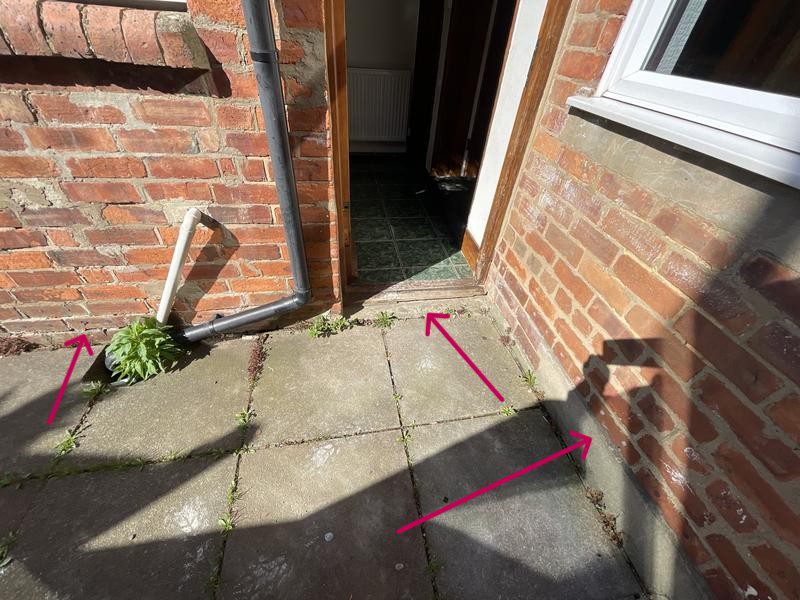
🟥 INSPECTION EXAMPLE
Survey Photograph: This inspection photograph shows paving laid almost level with the damp proof course, significantly reducing the recommended 150mm clearance. Although not every property with raised paving will experience damp, bridging the damp proof course increases the risk of moisture entering the wall and should be assessed as part of a RICS Home Survey.
| 🧱 Damp Risk | 🌬 Blocked Air Bricks |
|---|---|
| Raised levels can increase moisture exposure. | Reduced airflow may contribute to timber decay. |
| 🏠 Internal Damage | 💷 Future Repair Costs |
|---|---|
| Plaster and decorations may deteriorate. | Early correction is usually less costly than repairing resulting damage. |
How Are Raised Ground Levels Usually Fixed?
🧱 Lower External Ground Levels
Lower soil, paving or gravel where possible to restore the recommended 150mm clearance below the damp proof course. This is often the simplest and most effective solution where external ground levels are bridging the DPC.
💨 Clear Blocked Air Bricks
Remove soil, paving or vegetation obstructing air bricks so ventilation beneath suspended timber floors can be restored. Good airflow helps reduce the risk of condensation, dampness and timber decay.
🌿 Remove Vegetation
Cut back plants, climbing vegetation and shrubs growing against external walls. Keeping walls clear improves drying, reduces trapped moisture and allows defects to be monitored more easily.
🛠️ Install or Repair Drainage
Where surface water collects against the property, installing channel drains or improving drainage may help divert water away from the walls and reduce damp risks. Any drainage work should maintain the required clearance below the damp proof course.
Understanding the Recommended Detail
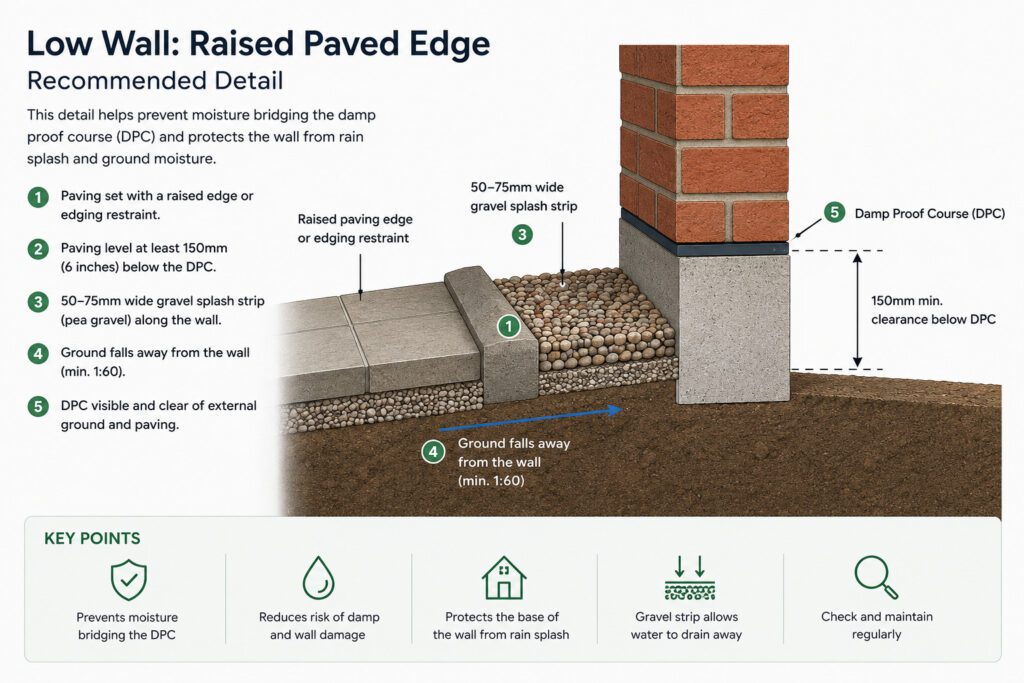
Maintaining the correct clearance between external ground levels and the damp proof course (DPC) is essential to help prevent moisture bridging. Raised paving, flower beds or soil positioned too close to the DPC can allow damp to bypass this protective barrier, increasing the risk of internal dampness and damage to finishes.
The recommended detail shown opposite helps manage surface water, protects the damp proof course and promotes effective drainage around the property, reducing the likelihood of future damp-related defects.
When Should You Get a Survey?
Raised external ground levels are only one of many defects that can affect a property’s condition. A RICS Home Survey helps identify damp, structural movement, roof defects, timber decay and other issues that may not be obvious during a viewing. Understanding these risks before exchanging contracts allows buyers to make informed decisions and avoid unexpected repair costs.
Frequently Asked Questions
Does high external ground levels always cause damp?
No. High external ground levels do not automatically cause damp, but they can increase the risk by reducing or bridging the damp proof course. Every property should be assessed individually, taking into account its construction, drainage and overall condition.
How much clearance should there be below a damp proof course?
Good building practice recommends that the damp proof course should normally remain at least 150mm above external ground level. This helps reduce the risk of moisture bridging the damp proof course and allows external walls to dry naturally.
Can blocked air bricks cause damp?
Yes. Air bricks provide ventilation beneath suspended timber floors. If they become blocked by soil, paving or vegetation, reduced airflow can increase the risk of condensation, timber decay and moisture-related defects.
Can raised external ground levels be repaired?
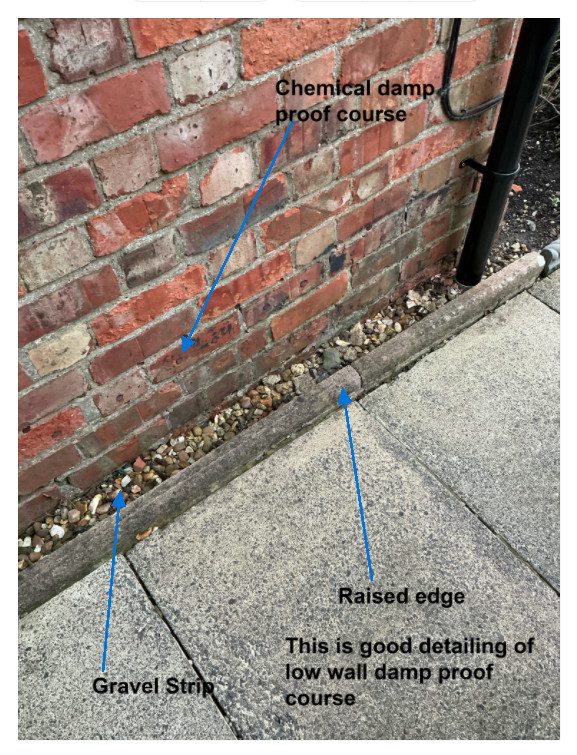
In many cases, yes. Repairs may include lowering external ground levels, improving drainage, clearing blocked air bricks or installing a free-draining gravel strip. The appropriate repair will depend on the property’s construction and the cause of the problem.
Will a RICS Home Survey identify this defect?
Yes. During a RICS Home Survey, our independent MRICS Chartered Surveyors inspect external ground levels, damp proof courses, drainage and visible signs of dampness. Where defects are identified, your report will explain the likely implications and recommend any further investigation or remedial work where appropriate.
Arrange Your RICS Home Survey
Buying a property with signs of damp or other building defects?
Our independent MRICS Chartered Surveyors provide RICS Home Surveys across the Midlands, East Anglia and the South East, helping buyers identify defects before they exchange contracts.